SPARK CONVERSATIONS
Rethinking Art and Society: About Artistic Research, Inclusion, and Art & Health with Ruth Mateus-Berr
November 5, 2026
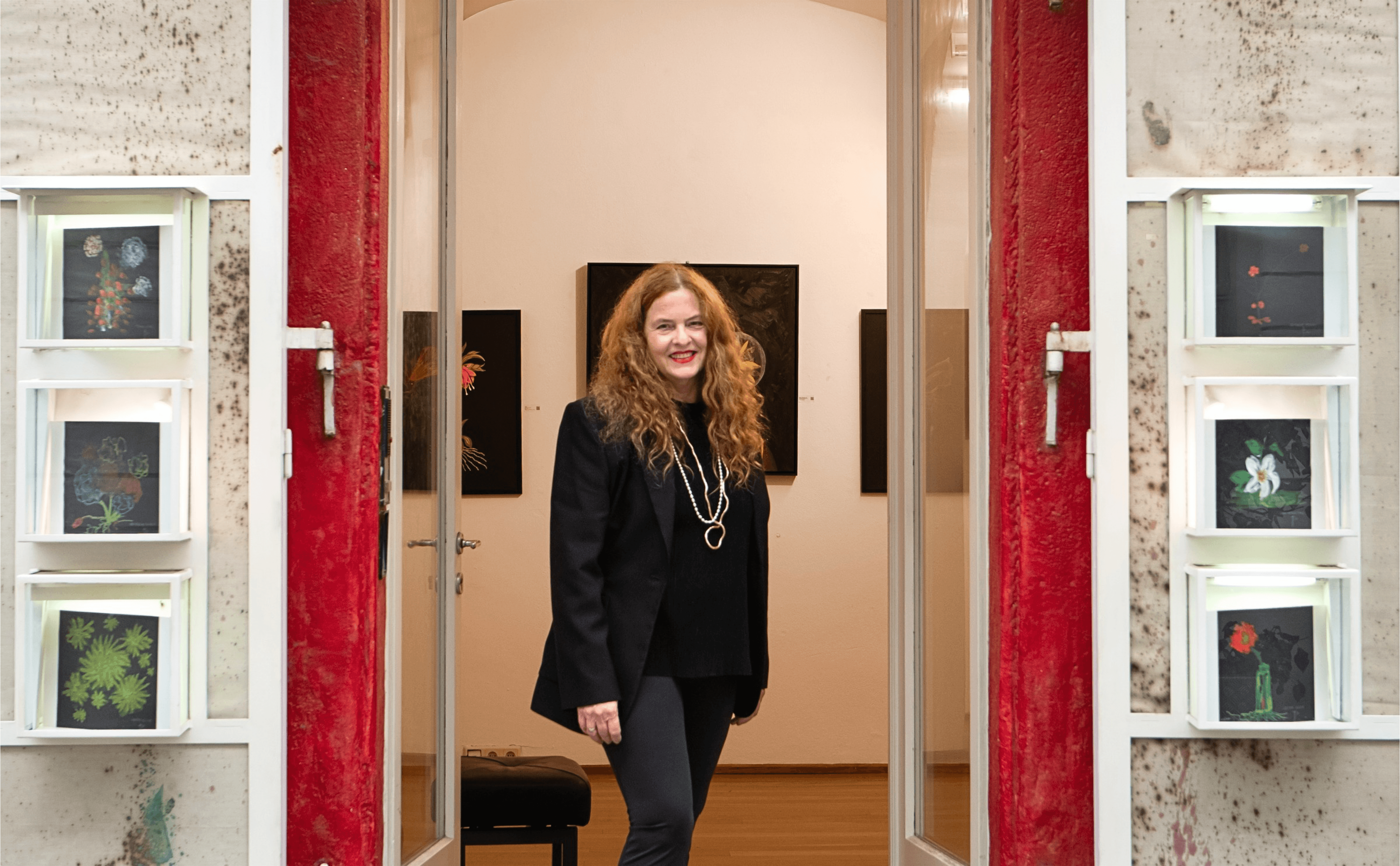
How can art foster resilience, challenge societal norms and create new forms of connection? In this conversation, Univ.-Prof. Dr. Ruth Mateus-Berr, professor at the University of Applied Arts Vienna and artist, explores the transformative potential of art and her research into the relationship between art and health. Drawing on her artistic practice, academic work and the DEMEDARTS project, she illustrates how participatory art can open up new perspectives on dementia, ageing and social diversity. She also reflects on the interplay between artistic freedom and social responsibility, as well as the importance of inclusive arts education.
SPARK: How did you find your way into the visual arts?
Ruth Mateus-Berr: I have always been passionate about drawing. My parents encouraged and nurtured my interest from an early age, introducing me to books and exhibition catalogues and taking me to museums, where I also attended workshops. To this day, I can still vividly recall the materials and their distinctive scents.
At seventeen, I went to southern France for what was supposed to be a language course. When my father’s borrowed camera broke, I began capturing everything that caught my eye with my watercolours instead. At the time, Aix-en-Provence was hosting the first major exhibition dedicated to Cézanne, and I visited his studio almost every day. It was in Cheval-Blanc, on the coast of the Camargue, that I eventually captured the golden hour, painting with my entire body, fully immersed in the process.
From that moment on, I knew I wanted to study art. Nothing and no one could stand in my way.
SPARK: As part of the artistic research project DEMEDARTS, you explored the discourse of an ageing society and corresponding artistic approaches. How did you approach this subject?
Ruth Mateus-Berr: It all began with a one-hour interview with a woman living with dementia, which continues to inspire me to this day. We asked participants to bring objects and photographs that were important to them.
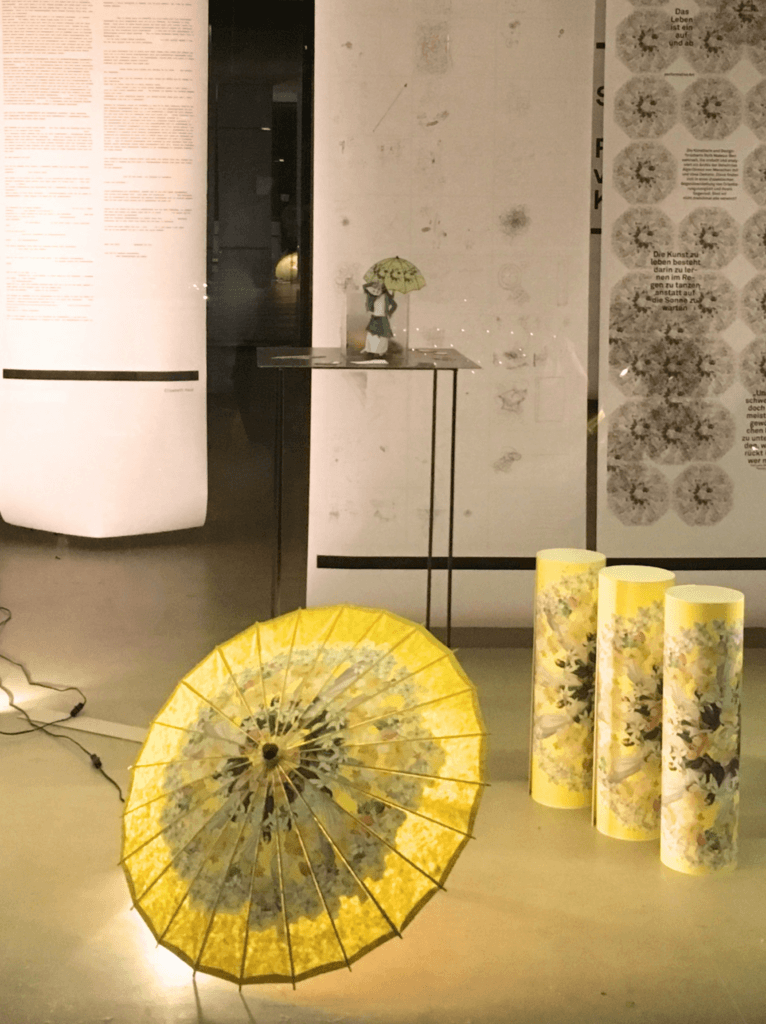
My interview partner arrived with an umbrella, Bach flower cards, and sayings such as: “You don’t have to wait for the sun; you can dance in the rain.” Above all, she expressed how completely alienated she felt from the design products intended for her age group. Even with dementia, she said, you have the right to be playful, funny and a little crazy.
This conversation inspired the creation of a yellow Japanese paper parasol, delicate in a way that reflects the fragility associated with the disease, adorned with her Bach flower cards arranged as a mandala. When you spin the parasol, she dances.
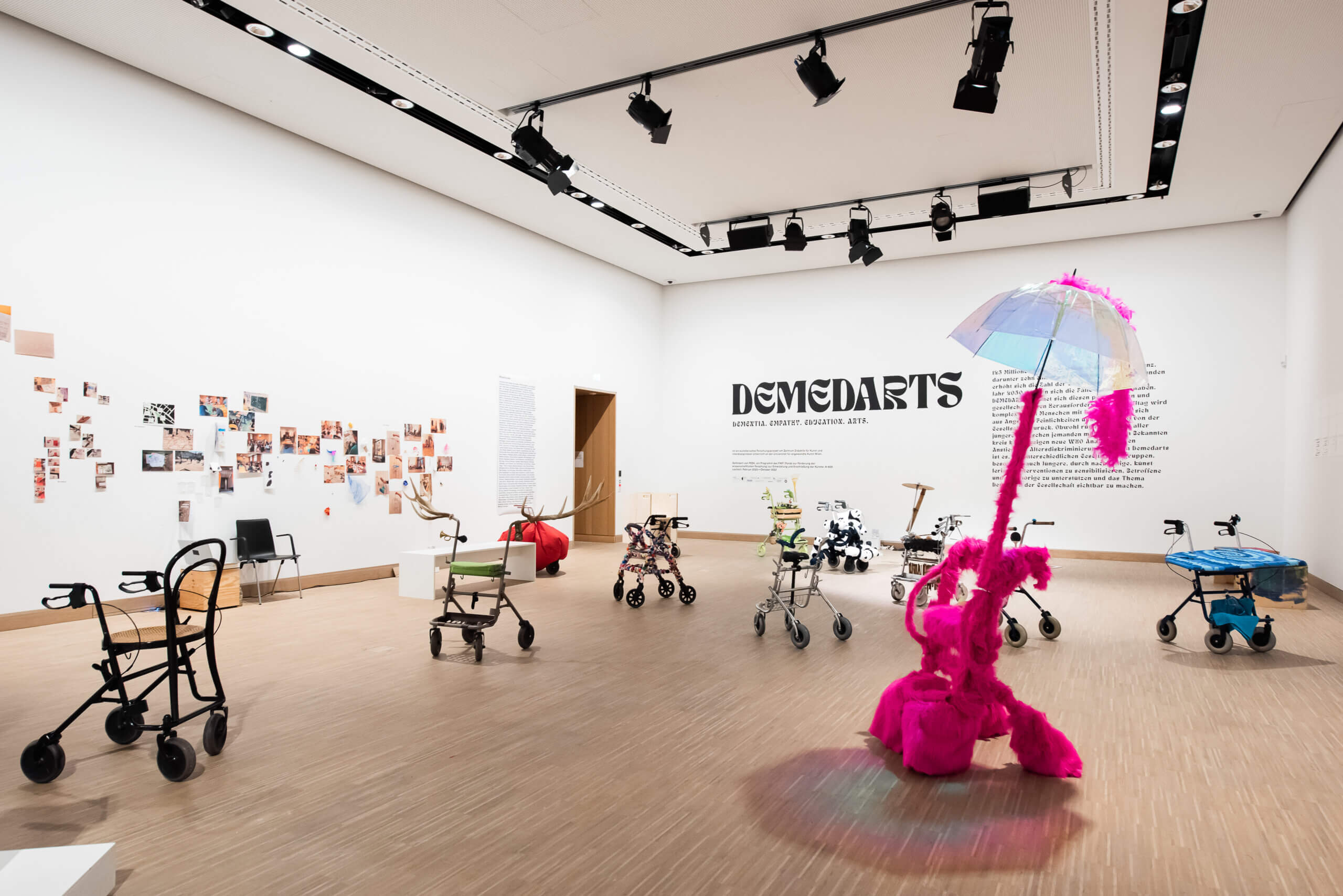
For an exhibition at Künstlerhaus, where everything had to be mobile, I developed a series of rollators: Pinky, a plush model with a feather boa; others inspired by professions, hobbies and design icons; and some that address rights often denied to older people, such as love, sexual autonomy and the freedom to move at speed.
SPARK: What surprised you most during this project? Were there any moments that particularly moved you?
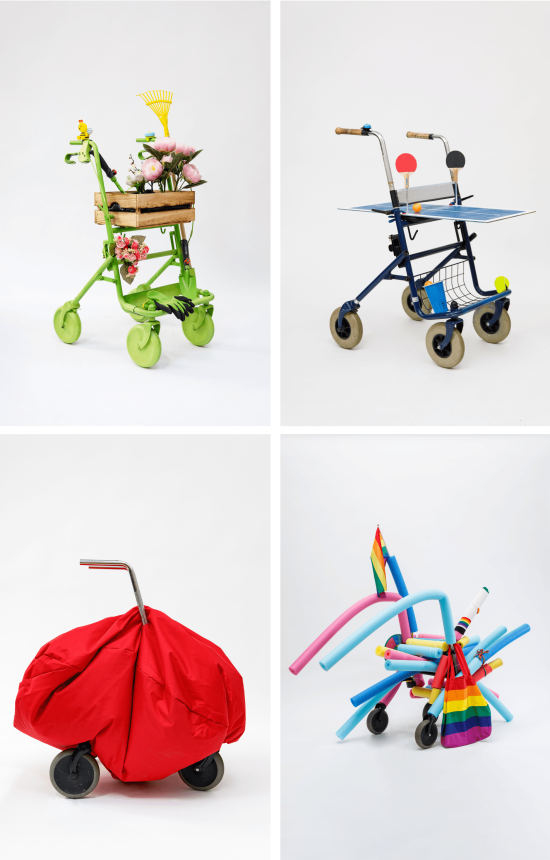
Ruth Mateus-Berr: What surprised us most was the response. Rather than simply looking at the rollators, visitors began interacting with them and designing their own for family members. Care facilities sent their teams to our workshops. One son wrote to us saying that his father finally wanted to use his rollator with pleasure. The only difference was that it had been individually designed for him.
What moved me most were the workshops themselves. During a collage session, a former opera singer began singing a song, and the others joined in. After an hour of artistic activity, a woman with advanced dementia began speaking in complete sentences again, to the speech therapist’s astonishment. At Pia Scharler’s interactive play table, people who spent most of their time in bed suddenly wanted to get up, while a man and a woman began to flirt quite openly as they tossed balls back and forth. When language is lost, the connection between people does not have to be lost as well.
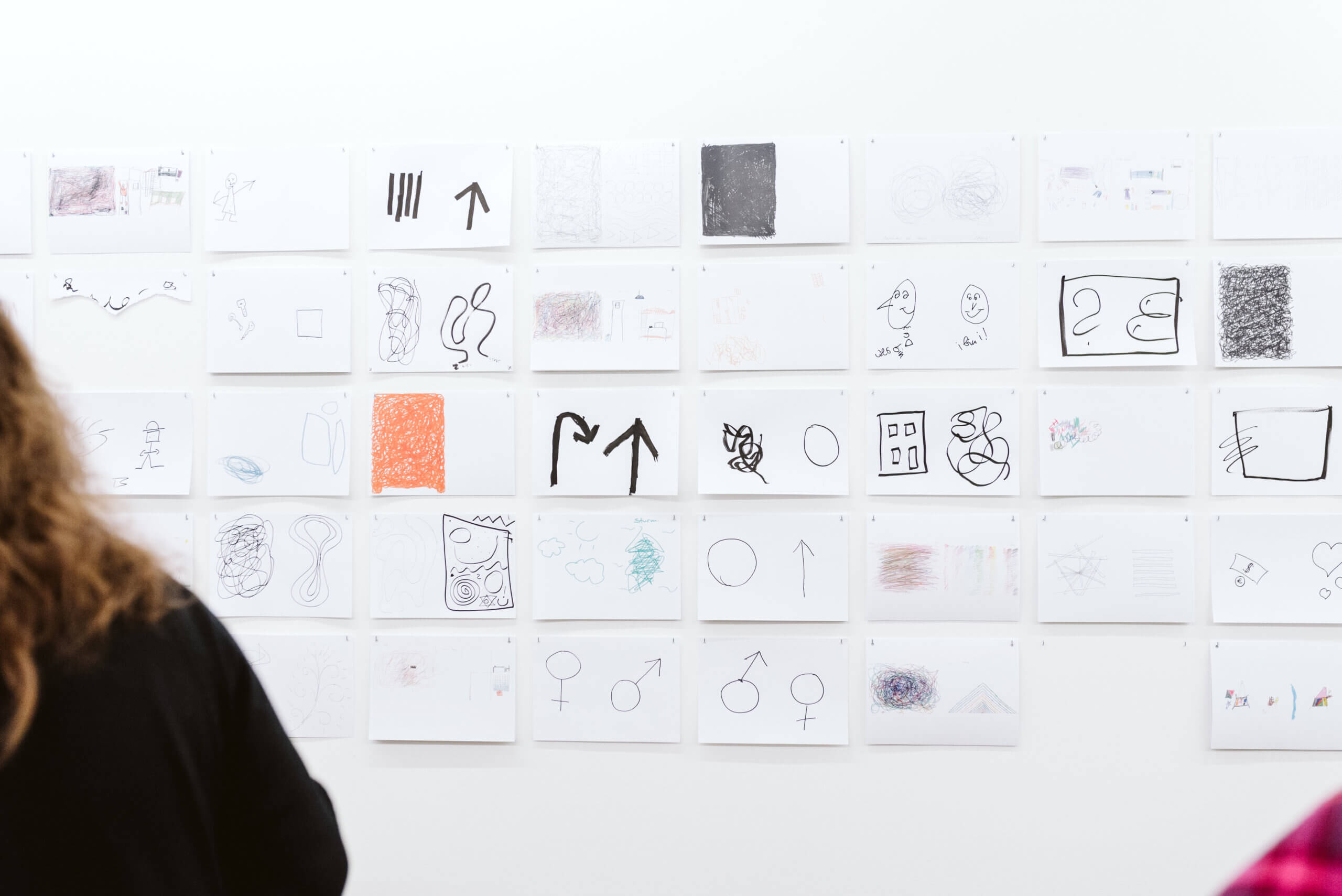
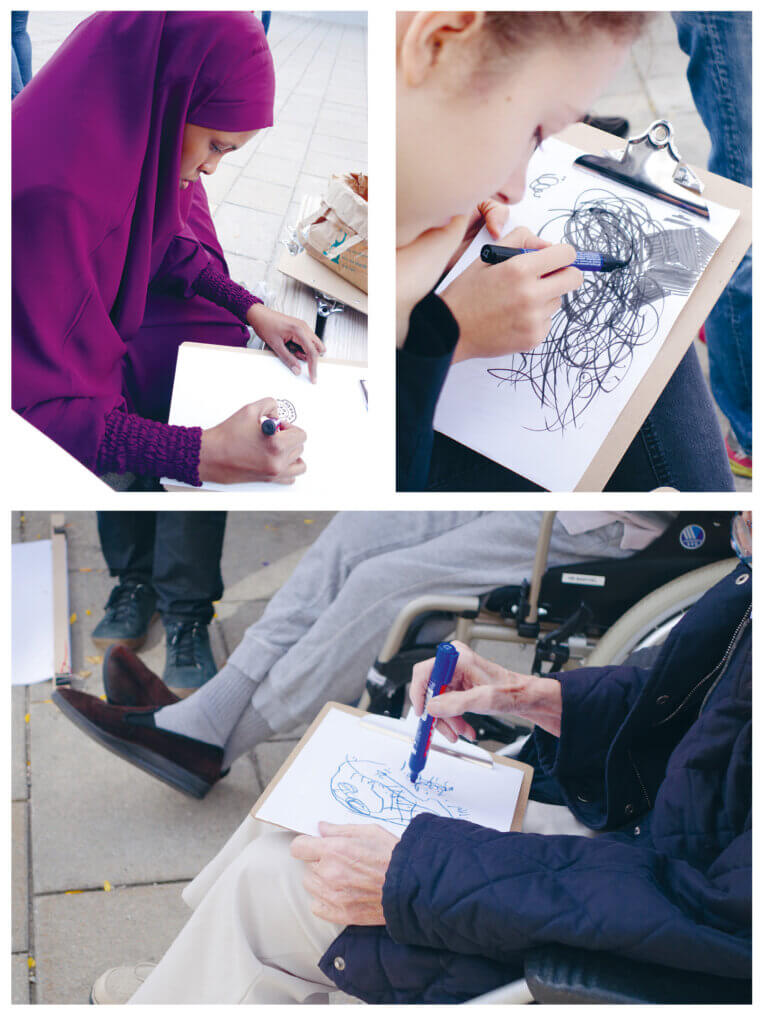
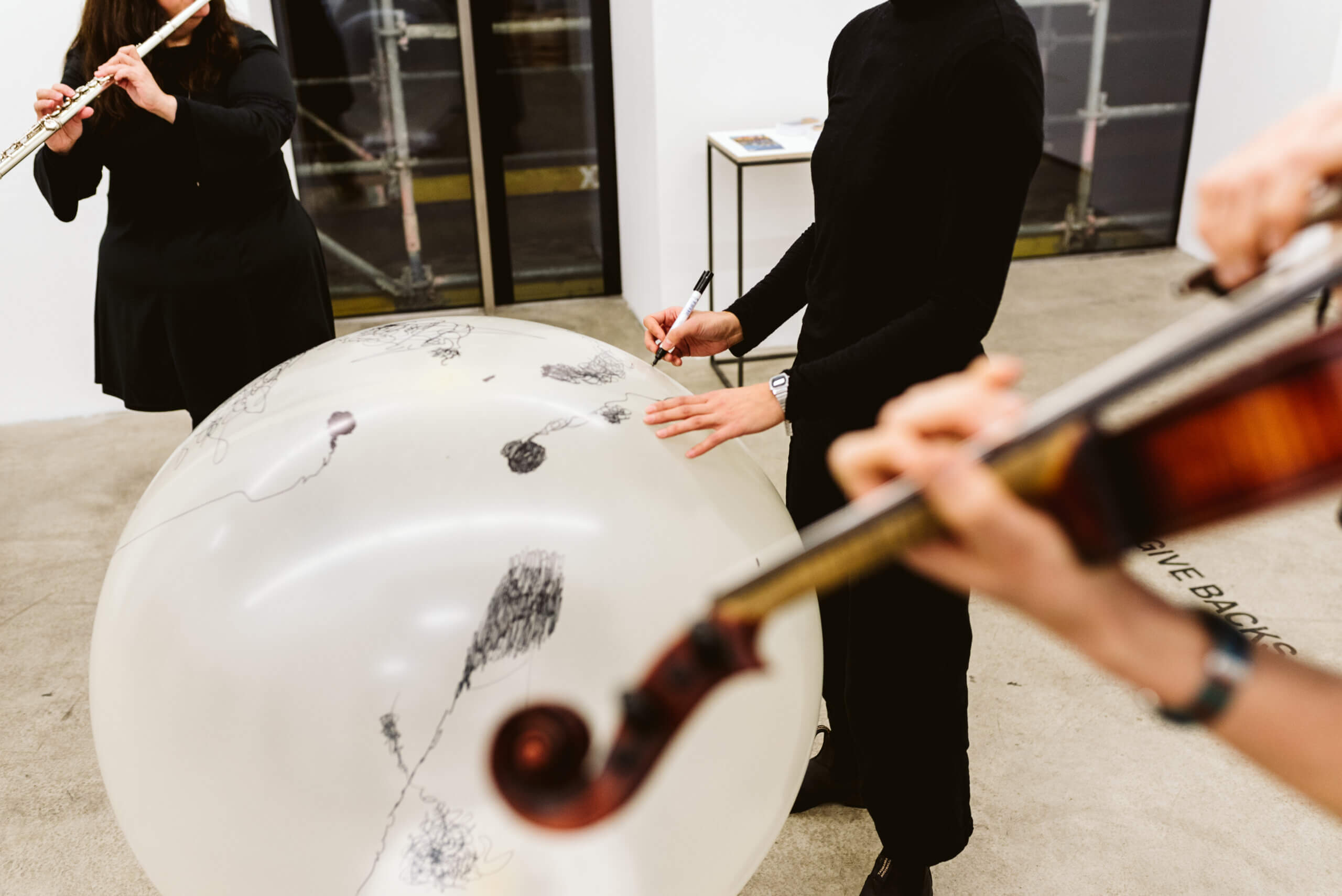
Another important element was the Archive of Confusions. Hundreds of people, with and without dementia, from Vienna to Tokushima, drew what confusion meant to them. Musicians then interpreted these drawings as musical scores.
Through our DEMEDARTS toolbooks, translated into nine languages, we offer children, family members and caregivers simple, creative ways to connect with people living with dementia.
Perhaps the most important insight was this: we set out to explore what art could do for people with dementia, only to discover how much we ourselves could learn from them.
SPARK: What role do you believe art plays in the personal and social development of individuals?
Ruth Mateus-Berr: For me, art is a fundamental form of knowledge and communication. It allows us not only to see the world as it is, but also to imagine how it could be. On a personal level, it sharpens our perception, nurtures curiosity and strengthens our ability to navigate uncertainty and ambiguity. On a societal level, it makes different lived realities visible and brings together people who might otherwise never meet. In doing so, it fosters precisely what democracy needs: the ability to shift perspectives and to live with ambivalence.
This is why art and visual communication, as well as technology and design, are not peripheral subjects but key disciplines. Design thinking — what Nigel Cross calls “designerly ways of knowing” — means that if solution A does not work, you look for B, C or D. Mistakes become insights, not failures.
At the same time, I resist reducing art to its usefulness. It is allowed to be purposeless, uncomfortable and simply beautiful. Art does not necessarily change the world directly, but it changes the way we perceive it — and that, in turn, can become the starting point for change.
SPARK: How do you raise your students’ awareness of these topics in your teaching at the University of Applied Arts Vienna, and how do they respond? How does their artistic practice change in this context?
Ruth Mateus-Berr: I work with artistic research, Social Design Thinking and participatory processes. Students engage with real-world issues such as dementia, inclusion, democracy, mental load and ecology, ideally not by working on behalf of people, but with them.
In DEMEDARTS, this was only possible to a limited extent due to the pandemic. We therefore invited a speaker who lives with dementia herself, as well as the president of Alzheimer Austria. Together with students from the University of Music and Performing Arts Vienna, we developed teaching concepts that were incorporated into our toolbooks.
For many students, this experience prompted them to critically reassess their own practice: Who am I designing for? Whom am I excluding? What responsibilities do I have? The focus shifted beyond the finished work to encompass the process itself.
This was not easy for everyone, particularly for those whose work is rooted in personal, subjective expression or who have experienced dementia within their own families. Yet it was precisely through these challenges that the most important insight emerged: artistic freedom and social responsibility are not mutually exclusive.
SPARK: How can participatory engagement in cultural life influence people’s physical and mental health?
Ruth Mateus-Berr: Quite significantly. In 2019, a World Health Organization report reviewed more than 3,000 studies, finding that artistic activities promote health, help prevent illness and support treatment. The social dimension is particularly important to me. Creating art together counteracts loneliness and gives people a tangible sense of agency and self-efficacy.
This is why Social and Cultural Prescribing is becoming increasingly important: visits to museums, choir participation or painting workshops are recommended as activities that promote health and well-being. This opens up an exciting field of work for future graduates of art universities, for example in care facilities, museums or preventive healthcare. I am convinced that art universities — and I hope the University of Applied Arts Vienna will be among them — will establish degree programmes in fields such as Arts & Health or art therapy.
At the same time, art must not be reduced to a medical tool. Its value also lies in the joy it brings, the connections it creates and the fundamental right of every individual to participate in cultural life on their own terms.
SPARK: You also explore questions of diversity and inclusion. What challenges do you currently see in arts education?
Ruth Mateus-Berr: I see three main challenges.
First, art in schools is still too often reduced to something decorative. Yet, since 2023, the curriculum has made cross-curricular themes such as political education, democracy and media literacy, as well as health promotion, a mandatory part of all subjects. Art and Design engages directly with the very images and media through which opinions are shaped today. Dementia, for example, touches on health promotion as well as discrimination: ageism is the most frequently experienced form of discrimination in Europe, even more prevalent than discrimination based on gender or origin.
Second, certain groups are easily overlooked, including people with disabilities and neurodivergent individuals, whose ways of learning are often perceived as deficits. Artistic processes, however, allow for different paces and forms of expression. At the University of Applied Arts Vienna, there is also a dedicated officer for students with disabilities.
Third, we need to address polarisation and postcolonial perspectives. Austria was not a conventional colonial power, but it was entangled in colonial structures. The Penacho of Moctezuma at the Weltmuseum Wien is one example. Here, I distinguish between guilt and responsibility: responsibility means researching the provenance of collections and making historical entanglements visible.
However, criticism must not create new forms of othering. When some students disparage queer people or are unwilling to engage emotionally with the Holocaust, neither looking away nor responding with counter-condemnation is helpful. What we need instead are education and compassion for all victims.
It all begins with language. Referring to people as “the demented”, derived from the Latin meaning “without mind”, reduces them to their condition. The way we speak about people shapes the way we treat them.
SPARK: How do you approach student autonomy and maturity when students fail to exercise their decision-making abilities, and how do you reconcile this with your responsibility towards the school?
Ruth Mateus-Berr: Students do not necessarily arrive at university with a fully developed sense of autonomy and maturity; these are qualities they learn and develop throughout their studies. When someone struggles to make decisions, my first step is to ask why. Often, the underlying causes are feeling overwhelmed, uncertainty or a fear of failure. In such cases, trust and open dialogue can make all the difference.
But the opposite can also occur: a form of autonomy that sees itself as beyond challenge and perceives criticism from mentors or more experienced colleagues as an attack. To me, maturity means being able to listen to different perspectives with curiosity, consider them critically and either accept or reject them on reasoned grounds. This is an essential aspect of professionalism, particularly in the teaching profession.
I also have a responsibility towards the school. That is why I communicate deadlines, assessment criteria and consequences clearly from the outset. Autonomy also means taking responsibility for the consequences of one’s own decisions. My role is to ensure that these consequences are understood in advance.
The importance of taking young people seriously as active co-creators is also demonstrated by the project UNITED NATURE DEMOCRACY, which develops visions of the future up to the year 2100 from the perspective of Generation Z.
SPARK: How has your understanding of art evolved throughout your academic and artistic career?
Ruth Mateus-Berr: My understanding has changed less than it has expanded. From my parents, I learned that art is diverse, sensory and open-ended. Since then, I have come to embrace participation and artistic research as well. Today, I see art as something that emerges between people. In DEMEDARTS, the works only truly came to life when visitors began touching them and developing them further.
Artistic research, in turn, makes creative processes open to reflection and enables fundamental research within the arts themselves. DEMEDARTS has generated at least three ideas for applied research.
So my understanding of art has not been replaced by a different one; it has grown broader. I have moved from seeing art as something I create to understanding it as something we create together and bring into the world to make an impact on society.
SPARK: What impact can one’s own artistic practice have on physical and mental health?
Ruth Mateus-Berr: For me, artistic practice has always strengthened my resilience. Whatever troubles or moves me takes on a form, and once something has a form, I can look at it with a certain distance and share it with others. My painting TANs – The Disappearance of Colours was created during lockdown, when we all experienced isolation of the kind that often accompanies life with dementia on a more permanent basis. I painted a delicate, finely rendered image and then covered it with a white veil. It was painful to do so, but that very act became a way of processing the experience.
With my diploma in art therapy and my training as a facilitator of Nonviolent Communication, based on the work of Marshall B. Rosenberg, I also understand this power from a professional perspective. Shaun McNiff has been a particularly important influence on me. He sees art as a medicine for the soul, with the healing power lying above all in the process itself.
In DEMEDARTS, we deliberately used art to promote the well-being of people living with dementia, their families and caregivers, helping to inspire the Arts 4 Health Austria project. In the edited volume Politik der Erfahrung (Politics of Experience), which I co-edited, we also explore the close connections between artistic experience, politics, education and art therapy.
Artistic work can also be demanding and unsettling. Yet it is precisely for this reason that it teaches us how to navigate uncertainty and find new ways forward.
SPARK: What role does your own artistic practice play in your work as a professor and researcher?
Ruth Mateus-Berr: For me, it is a question of credibility: I cannot ask my students to do something I do not practise myself. I have always maintained my own studio and participated in exhibitions. This artistic practice is the foundation of my teaching and research. When you work as an artist yourself, you know the experience of facing a blank page, of failing and of succeeding. The same applies to academia: rejection and revision are part of the process, and conducting your own research is the best form of professional development. Anyone who teaches must remain up to date with developments in their field.
As a professor, you are constantly passing on ideas that others take up and develop further. That is an essential part of teaching, but it can easily push your own artistic practice into the background. We must not allow that to happen. Only those who continue to conduct research, question their assumptions and create their own work remain engaged, vital and credible.
This is why I consider supporting artistic research so important. DEMEDARTS would not have been possible without the FWF’s PEEK programme.
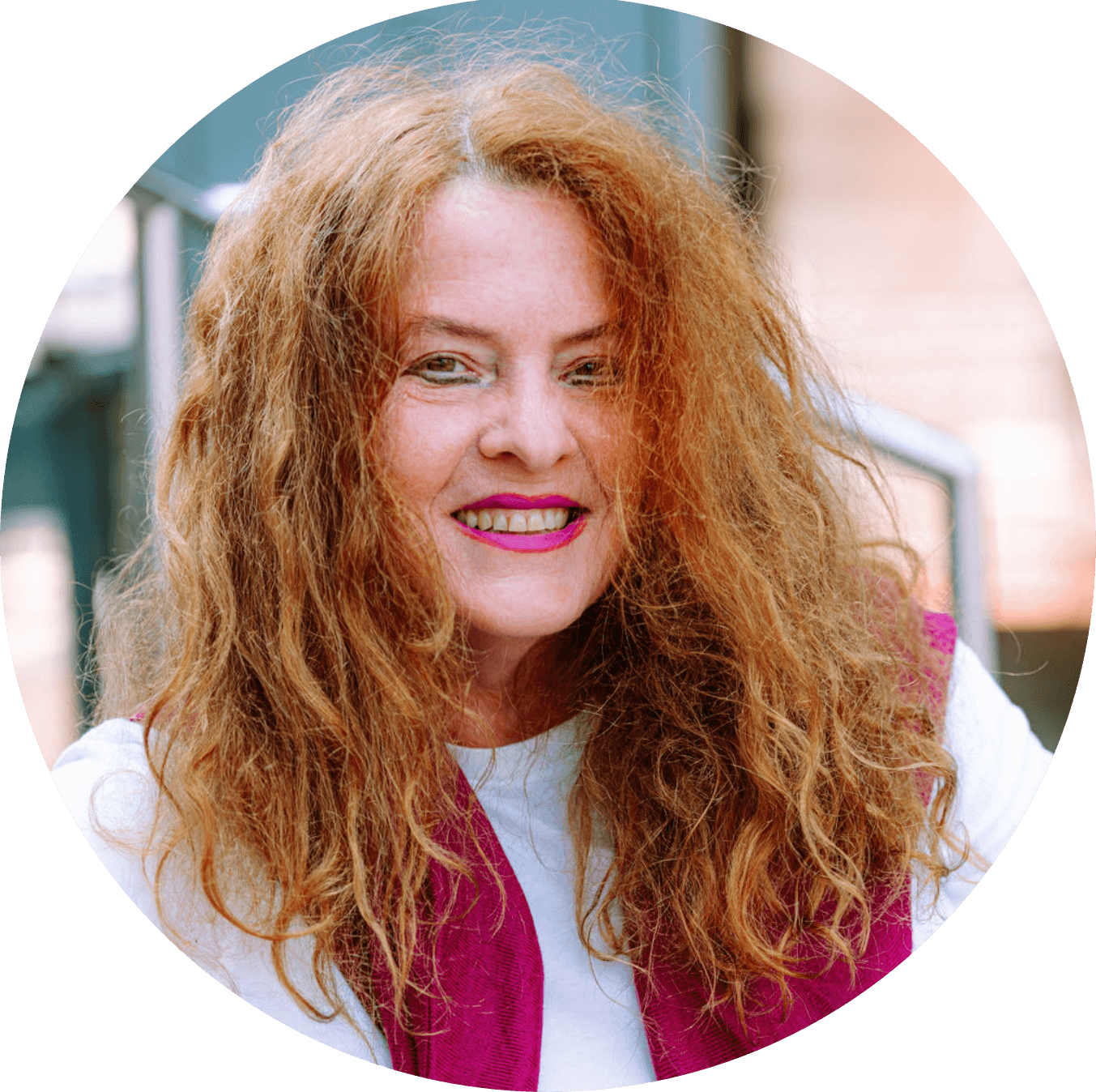
Ruth Mateus-Berr
Artist, Head of the Center for Didactics of Art and Interdisciplinary Education at University of Applied Arts Vienna
Photo © Valerie Marie Voithofer
Dania Kwizda-Dejanoff
International Relations SPARK Art Vienna
Photo © Sabine Hauswirth